Let's be honest: most homeowners' eyes glaze over when contractors start talking about R-values, thermal bridging, and heat transfer coefficients. But here's the thing about radiant barriers—the science behind them is actually pretty cool (pun absolutely intended). And understanding how they work helps you appreciate why they're so effective at slashing cooling costs in North Carolina's brutal summers.
Don't worry—we're not going to make you sit through a physics lecture. But a little science knowledge will help you understand why installing a thin sheet of shiny material in your attic can genuinely save you hundreds of dollars a year on cooling costs. Let's break down the science behind radiant barriers in a way that's actually interesting.
Heat Transfer 101: The Three Ways Heat Moves
To understand radiant barriers, you first need to know that heat moves in three different ways. Think of them as heat's transportation options:
1. Conduction: The Direct Contact Method
Conduction is heat moving through direct contact between materials. Touch a hot stove? That burning sensation is conductive heat transfer. Heat moves from the hot surface directly through the material into your hand.
In your home, conduction happens when heat moves through your roof, walls, and ceiling. On a hot summer day, your roof absorbs heat from the sun, and that heat conducts through the roofing materials, sheathing, and rafters.
What stops it: Traditional insulation materials like fiberglass and cellulose are designed to slow conductive heat transfer by trapping air pockets.
2. Convection: The Air Current Method
Convection is heat moving through air or liquid currents. Hot air rises (because it's less dense), cold air sinks (because it's denser), creating a cycle. That's why your upstairs is always hotter than downstairs—physics in action.
In your attic, convection occurs as hot air rises to the peak and (hopefully) escapes through ridge vents, pulling cooler air in from soffit vents.
What stops it: Insulation also reduces convective heat transfer by minimizing air movement. Proper ventilation manages convection by allowing hot air to escape.
3. Radiation: The Invisible Wave Method
Here's where it gets interesting. Radiant heat doesn't need direct contact or air movement—it travels through empty space via electromagnetic waves. It's how the sun warms your face, even though there's 93 million miles of nothing between you and the sun.
In your attic, radiant heat is the invisible villain. Your sun-baked roof (which can reach 160-170°F on a summer day) radiates heat downward toward your cooler attic floor, insulation, and ceiling. This radiant heat passes right through air and even through traditional insulation.
What stops it: This is where radiant barriers shine (again, pun intended). Traditional insulation doesn't effectively stop radiant heat—but reflective materials do.
Why Traditional Insulation Alone Isn't Enough
Here's the problem: traditional attic insulation is fantastic at slowing conduction and convection, but it's not designed to stop radiation. Radiant heat passes through fiberglass and cellulose insulation like it's barely there, warming it up and turning your insulation into a giant heat source radiating into your living space.
It's like wearing a thick winter coat in the sun. The coat insulates you, but you're still absorbing radiant heat from the sun and getting uncomfortably warm. You need something that reflects the sun's rays—like a hat with a reflective surface.
That's exactly what a radiant barrier does for your attic.
How Radiant Barriers Work: The Physics
Radiant barriers are made of highly reflective materials—typically aluminum foil—with a low emissivity rating. "Emissivity" is the measure of how much radiant heat a material emits or absorbs. It's measured on a scale from 0 to 1:
- High emissivity (0.90): Materials like wood, asphalt shingles, and standard insulation absorb and re-radiate most of the heat hitting them
- Low emissivity (0.03-0.10): Reflective materials like aluminum foil reflect 90-97% of radiant heat
When radiant heat from your hot roof hits a radiant barrier with an emissivity of 0.03, about 97% of that heat bounces back toward the roof instead of being absorbed and transferred to your attic space and insulation.
The Air Gap: Critical for Effectiveness
Here's a crucial detail: for a radiant barrier to work, it must have an air gap on at least one side. Radiant heat only transfers across open space. If the reflective surface is touching something (like insulation or roof decking), heat can transfer via conduction, bypassing the reflective properties.
That's why radiant barriers are typically installed either:
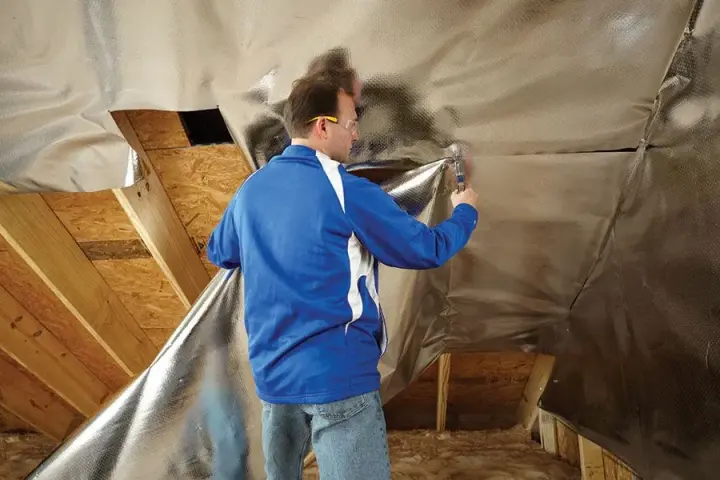
- Stapled to the underside of roof rafters (with an air gap between the roof deck and the foil)
- Laid on top of attic floor insulation (with an air gap between ceiling and foil)
In both cases, the air gap allows the radiant barrier to reflect heat instead of conducting it.
Real-World Performance: What the Research Shows
Laboratory testing is great, but what matters is real-world performance. Multiple studies have measured radiant barrier effectiveness in actual homes:
Department of Energy Studies
The U.S. Department of Energy reports that radiant barriers can reduce cooling costs by 5-10% in warm, sunny climates. In particularly hot climates or homes with ductwork in the attic, savings can reach 16%.
Florida Solar Energy Center Research
Florida—a state that knows a thing or two about hot weather—conducted extensive field testing. They found:
- Radiant barriers reduced attic temperatures by 20-30°F
- Cooling costs dropped 8-12% on average in the Southeast
- Homes with attic ductwork saw the highest savings
- Payback periods ranged from 6-7 years with 15-19% return on investment
North Carolina Performance
In the Triad area—Greensboro, Winston-Salem, and High Point—radiant barriers perform exceptionally well because we have:
- Intense summer sun
- High cooling loads (AC runs a lot in summer)
- Many homes with attic ductwork
- Dark-colored roofs that absorb maximum heat
We regularly see 10-15% cooling cost reductions in local homes after radiant barrier installation.
The Math Behind the Savings
Let's put some numbers to this science. Imagine a typical Triad area home on a 95°F summer day:
Without Radiant Barrier:
- Roof surface temperature: 170°F
- Attic air temperature: 145°F
- Heat radiating onto insulation: Significant
- Insulation temperature: 120-130°F
- Ceiling temperature: 90-95°F
- Impact on AC: Constant battle against heat gain from above
With Radiant Barrier:
- Roof surface temperature: 170°F (same—the roof still gets hot)
- Radiant barrier reflects 97% of radiant heat back toward roof
- Attic air temperature: 115-125°F (20-30°F cooler)
- Heat radiating onto insulation: Dramatically reduced
- Insulation stays cooler and more effective
- Ceiling temperature: 80-85°F
- Impact on AC: Less heat gain to overcome = less runtime = lower bills
That 20-30°F reduction in attic temperature translates directly to reduced heat transfer into your living space, meaning your AC has less heat to remove.
Why Radiant Barriers Work Best in Hot, Sunny Climates
Radiant barriers aren't equally effective everywhere. They're specifically designed for climates with high cooling loads and intense sun—which perfectly describes North Carolina summers.
Where They Excel:
- Hot climates: The hotter the sun, the more radiant heat to reflect
- Sunny regions: Consistent solar exposure maximizes benefits
- Cooling-dominated climates: They primarily reduce cooling costs, not heating costs
- Homes with air conditioning: Savings come from reduced AC runtime
Where They're Less Beneficial:
- Predominantly cold climates (little cooling load)
- Cloudy regions with limited direct sun
- Homes without AC (no cooling costs to reduce)
The Triad area checks all the boxes for maximum radiant barrier effectiveness: hot summers, intense sun, significant cooling loads, and widespread AC use.
Radiant Barriers + Insulation: Better Together
Here's a critical point: radiant barriers don't replace traditional insulation—they complement it. Think of them as a dynamic duo:
- Traditional insulation: Slows conductive and convective heat transfer, provides R-value, works year-round
- Radiant barrier: Reflects radiant heat, has no R-value, primarily benefits cooling season
Together, they create a comprehensive defense system:
- Radiant barrier reflects 97% of radiant heat back toward roof
- Ventilation removes hot air that does accumulate
- Insulation prevents remaining heat from conducting into living space
This triple-layer approach can reduce cooling costs by 30-45% compared to an unprepared attic with inadequate insulation and no radiant barrier.
Common Misconceptions About Radiant Barriers
Myth 1: "Radiant Barriers Have No R-Value, So They're Not Real Insulation"
This is technically true but misleading. R-value measures resistance to conductive heat flow—which isn't what radiant barriers do. Saying radiant barriers don't work because they have no R-value is like saying umbrellas don't work because they don't keep you warm. Different problems require different solutions.
Myth 2: "You Don't Need Insulation If You Have a Radiant Barrier"
Absolutely false. Radiant barriers and insulation serve different purposes and work best together. Skipping traditional insulation will cost you in both summer and winter.
Myth 3: "Radiant Barriers Save Money on Heating Too"
Radiant barriers provide minimal winter heating benefit. While they can slightly reduce radiant heat loss from your attic floor to the roof, the effect is much less dramatic than summer cooling benefits. They don't hurt heating efficiency, but don't expect significant winter savings.
Myth 4: "All Radiant Barriers Perform the Same"
Quality matters. Pure aluminum foil laminated to durable backing materials performs better and lasts longer than cheaper alternatives. Installation quality also dramatically affects performance—proper air gaps and coverage are essential.
Maximizing Radiant Barrier Effectiveness
To get the most from your radiant barrier investment:
- Ensure proper ventilation: Radiant barriers work best when combined with good attic ventilation that removes hot air
- Maintain adequate insulation: Have at least R-49 insulation in your attic (Climate Zone 4 requirement)
- Choose quality materials: Pure aluminum foil with durable backing lasts longest and performs best
- Install correctly: Proper air gaps and complete coverage are critical
- Keep it clean: Dust accumulation reduces reflectivity (though this mainly affects horizontal installations)
The Bottom Line: Real Science, Real Savings
Radiant barriers aren't marketing hype or pseudoscience—they're based on well-understood physics and backed by decades of field testing. By reflecting radiant heat instead of absorbing it, they reduce attic temperatures by 20-30°F and cooling costs by 10-16% in hot climates.
For North Carolina homeowners, particularly in the Triad area, radiant barriers are one of the most cost-effective ways to improve summer comfort and reduce energy bills. They don't replace traditional insulation, but they make it work better by reducing the heat load it must handle.
At 4 Seasons Insulation, we install radiant barriers as part of comprehensive attic upgrades. We ensure you have adequate insulation first (radiant barriers work best when paired with proper insulation), then add a professionally installed radiant barrier for maximum summer performance.
Curious whether a radiant barrier makes sense for your home? Contact us for a free attic assessment. We'll evaluate your current setup and provide honest, science-based recommendations for improving your home's energy efficiency.
Because understanding the science helps you make smart decisions—and smart decisions lead to lower energy bills and a more comfortable home.